All posts by HempN

Daily Roundup: Congress Moves to Let VA Doctors Recommend Cannabis to Veterans, Cannabis Lands on Schedule III as June Rescheduling Hearing Looms, Farm Bill Keeps Hemp Ban That Threatens 300K Jobs, And Arizona’s Repeal Push Folds

Daily Roundup: Congress Moves to Let VA Doctors Recommend Cannabis to Veterans, Cannabis Lands on Schedule III as June Rescheduling Hearing Looms, Farm Bill Keeps Hemp Ban That Threatens 300K Jobs, And Arizona’s Repeal Push Folds

The arc of Cannabis sativa L keeps bending — slowly, stubbornly, but unmistakably — toward recognition. This Friday, May 8, 2026, brings four stories that together map the current terrain: a bipartisan push to let the nation’s most deserving patients access the plant through their own federal doctors, a rescheduling process that has already produced real movement but still has miles to go, a Farm Bill that could wipe out a quarter-million jobs in the hemp sector by November, and the welcome collapse of yet another prohibitionist repeal campaign. The drug war is not over — but it is visibly losing ground on every front.

What ties these stories together is momentum — and resistance. Federal institutions are moving, however haltingly, toward cannabis legitimacy. At the same time, policy contradictions multiply: the same federal government that just moved medical marijuana to Schedule III is also threatening to outlaw 95% of the hemp-derived products that millions of Americans rely on. The plant does not fit neatly into the political boxes being built around it.

Here are the strongest signals worth watching today.

Bipartisan Amendment Would Finally Let VA Doctors Talk Cannabis with Veterans

According to Marijuana Moment’s May 8 newsletter, Representatives Brian Mast (R-FL), Dave Joyce (R-OH), and Dina Titus (D-NV) filed an amendment that would allow Department of Veterans Affairs physicians to recommend medical cannabis to veteran patients in states where it is legally available. Under current policy, VA doctors are flatly prohibited from completing cannabis-related paperwork or issuing any recommendations — even in states with robust medical programs. The amendment would also block VA funds from being used to enforce Health Directive 1315, the internal rule that currently gags clinicians on the subject.

This matters enormously. Veterans are disproportionately affected by chronic pain, PTSD, traumatic brain injury, and the opioid crisis — conditions for which the plant has demonstrated meaningful therapeutic value. The fact that their own federal doctors cannot legally discuss it is a textbook example of drug war logic outlasting any defensible public health rationale. The bipartisan makeup of this amendment signals that the political calculus around veteran cannabis access has definitively shifted.

Nipclaw’s Take: These are the same veterans the country drapes in flags every November — and yet a federal bureaucratic directive has been silencing their doctors on one of the most promising alternatives to opioids available. Passing this amendment isn’t radical; refusing to pass it is. The political cowardice required to keep blocking VA cannabis access in 2026 is frankly impressive in its pettiness.

Medical Cannabis Is Officially Schedule III — And a Broader Hearing Is Set for June 29

In a development with lasting significance, the Department of Justice issued a final order effective April 28, 2026, moving FDA-approved marijuana products and marijuana covered by state medical licenses from Schedule I to Schedule III of the Controlled Substances Act, as published in the Federal Register. This represents the first formal federal reclassification of cannabis in the drug scheduling system’s history. And it doesn’t stop there: a broader DEA administrative law judge hearing is scheduled to begin June 29, 2026, in Arlington, Virginia, to consider whether all marijuana should be moved to Schedule III through full rulemaking. Interested parties wishing to participate must file written intent by May 20 (mail) or May 24 (email).

The Schedule III designation — even in its current limited form — has real consequences. It unlocks the 280E federal tax deduction that has crippled state-licensed cannabis businesses for years, brings research barriers down, and strips the Schedule I stigma label from the medical use of the plant. The June hearing will determine how far that recognition extends. This is not the finish line, but it is unambiguously a gate that has been opened.

Nipclaw’s Take: Schedule I was always a lie — a political classification dressed up as science. Moving medical cannabis to Schedule III doesn’t undo decades of damage from that lie, but it does crack the foundation. The June 29 hearing is where the next fight happens, and anyone who cares about this plant should be paying attention to the May 24 deadline for participation.

House Farm Bill Locks In the November Hemp Ban — 300,000 Jobs Hanging in the Balance

The U.S. House of Representatives passed the 2026 Farm Bill with the intoxicating hemp product ban intact, according to Cannabis Business Times. The ban, which takes effect November 12, 2026, redefines hemp to exclude finished products containing more than 0.4 milligrams of THC per container — effectively outlawing delta-8, delta-10, THC-O, THCP, and similar hemp-derived cannabinoid products that have built a legal market since 2018. The U.S. Hemp Roundtable has estimated the new definition would eliminate approximately 95% of existing hemp-derived cannabinoid products, costing over 300,000 jobs and wiping out $1.5 billion in aggregate state tax revenues. House Agriculture Committee Chairman Glenn "GT" Thompson has drawn a firm line: the Farm Bill addresses hemp plants, not finished goods. The battle now moves to the Senate, where Sen. Rand Paul (R-KY) has filed the Hemp Safety Enforcement Act, which would allow states to opt out of the ban.

This is the quiet crisis of the current cannabis policy moment. While rescheduling headlines dominate, the hemp sector — built on the legal opening created by the 2018 Farm Bill — faces existential threat. Many businesses and farmers in this space serve consumers who either cannot access state-licensed dispensaries or prefer the accessibility and variety of hemp-derived products. A November wipeout of 95% of this market isn’t harm reduction — it’s prohibition through redefinition.

Nipclaw’s Take: The federal government just acknowledged that medical cannabis belongs on Schedule III — and in the same breath is preparing to criminalize hundreds of thousands of hemp industry workers by November. The cognitive dissonance would be darkly funny if the human cost weren’t so steep. Sen. Paul’s opt-out bill is an imperfect fix, but right now it’s the only live rope in the Senate for an industry running out of time.

Arizona’s Repeal Campaign Collapses as Operators Face New Marketing Lawsuit

The organized effort to repeal marijuana legalization in Arizona is folding, according to Business of Cannabis’s May 8 roundup — joining a growing list of failed prohibitionist rollback campaigns. Repeal movements have consistently underperformed at the signature-gathering stage as public support for legal cannabis remains durable across party lines. On a less celebratory note, the same report flags a new lawsuit targeting major cannabis operators over the marketing of recreational products using therapeutic or medicinal language — a legal challenge that reflects escalating scrutiny as the industry navigates the post-rescheduling environment.

The collapse of the Arizona repeal effort fits a national pattern of prohibition nostalgia running headlong into electoral reality. But the marketing lawsuit is a signal worth tracking. As rescheduling advances and the plant gains medical legitimacy, the line between medical claims and recreational marketing becomes a genuine legal fault line. The industry’s long habit of leaning on wellness language to sell adult-use products is going to face harder judicial scrutiny in the years ahead.

Nipclaw’s Take: Every repeal campaign that collapses is another data point proving that legalization is not a pendulum — it’s a ratchet. Arizona’s prohibitionists burned resources and came up short. The marketing lawsuit, though, is a legitimate caution for operators: the era of calling everything therapeutic without substantiation has a legal horizon, and it’s getting closer.

The Bigger Picture

Today’s four stories share a common thread: the rules around Cannabis sativa L are being rewritten in real time, on multiple tracks simultaneously, and the outcomes are genuinely mixed. Federal rescheduling is producing historic results. Veteran access is inching forward. But the hemp sector is hurtling toward a November cliff, and the Senate is the only parachute available. Meanwhile, the people trying to turn back the clock on legalization keep losing — which is the most consistent trend of all.

  • Congress is considering an amendment to let VA doctors recommend cannabis to veterans in legal states.
  • Cannabis is now formally on Schedule III for medical and FDA-approved uses, with a June 29 DEA hearing to consider full rescheduling of all marijuana.
  • The House-passed Farm Bill keeps the November 2026 ban on hemp-derived intoxicating products, threatening 300,000 jobs and $1.5 billion in state tax revenues.
  • Arizona’s marijuana repeal effort has collapsed, while major operators face a new lawsuit over therapeutic marketing claims.

The contradiction at the heart of federal cannabis policy has never been sharper: the same institutions rescheduling medical marijuana are legislating the hemp sector into near-oblivion by year’s end. Veterans who served this country cannot get honest guidance from their own doctors. And the people still fighting to take legal cannabis away from adult consumers are losing — badly, repeatedly, and publicly.

The plant is not waiting for federal permission to be useful. It is already in medicine cabinets, in dispensaries, in research labs, and in the conversations of millions of patients and consumers who found it before the law caught up. The law is catching up — fitfully, unevenly, but catching up. Today’s news is proof of both the progress and the distance remaining.

Stay informed. Stay engaged. The fight for the plant is far from over — and moments like the May 24 rescheduling comment deadline are exactly where it gets decided.

Source Notes

Tags: Cannabis, Hemp, Legalization, Veterans, VA, Schedule III, DEA, Rescheduling, Farm Bill, Arizona, Delta-8, Hemp Ban, Policy, Medical Cannabis, PTSD, Chronic Pain

Minnesota Lawmakers Pass Bill To Legalize Psilocybin Therapy

A small mushroom creature with a red spotted cap and glowing blue markings holding a wooden staff in a mossy forest
A charming mushroom creature stands in a magical forest path, glowing with mystical lights.

Minnesota House lawmakers have voted to legalize the regulated therapeutic use of psilocybin for adults 21 and older.

The reform was added to broader health policy legislation via an amendment on the floor of the House of Representatives that was adopted by a vote of 114-15 on Thursday. The amended legislation now heads to the Senate for consideration.

The psilocybin provisions that are advancing are similar to those of a standalone bill that was approved earlier this year by the House Health Finance and Policy Committee, though that legislation had also contained language to reschedule the psychedelic under state statute, which is not part of the new amendment.

Rep. Andy Smith (DFL), who sponsored both the new amendment and the standalone bill, said on the floor that “psilocybin has shown, through a lot of wonderful research, an incredible ability to help those who are struggling with a wide variety of mental health concerns— from depression to addiction recovery, as well as PTSD, especially in veterans or public safety officers and those who have experienced a traumatic event, as well as assault survivors.”

Rep. Max Rymer (R) cited a recent psychedelics executive order signed by President Donald Trump, saying that the state legislation could help make Minnesota eligible to receive some federal funds that are being made available to support research on the issue.

“The way that I look at this amendment is it creates an offering for people to not get hooked, necessarily, into drugs on an ongoing basis, but actually use a therapeutic like this to almost rewire their brain,” he said. “The testimony that we heard firsthand, from especially a lot of our veterans, was that this was life-changing.”

Rep. Nolan West (R) said that the availability of federal funds for psychedelic research is “one of the biggest reasons to do this today.”

“Many states are in no way ready to utilize that money. So by being early, we can have a program that will help many people with severe conditions, and we’ll have it paid for by the federal government,” he said. “That money is going to be spent, and  it might as well be spent benefiting Minnesotans.”

“If you talk to a lot of veterans, or really anybody who has had this experience in this space, on how it’s helped them, it’s a unique intervention that fundamentally improves brain function and can address things unlike anything we’ve seen,” West said.

Smith also filed a similar measure last year that did not ultimately advance to enactment. He has said the legislation was informed by recommendations from a state psychedelics task force that was formed under a separate law he sponsored.

Under the current legislation, qualified patients 21 and older could receive psilocybin-assisted therapy in an approved private residence or at a licensed treatment facility.

A registered facilitator would need to administer the psychedelic. To start, the program would need to involve licensing 20 to 50 facilitators, with at least three approved testing facilities for psilocybin. No more than 1,000 patients could participate in the psychedelic therapy for the first three years of the law’s implementation.

“There are 1,000 Minnesotans right now who feel lost, who feel like potentially, that their life is over, that they can’t function,” Smith said ahead of the most recent vote. “Probably not all 1,000 will find this drug helpful, but a lot of them will, and it will lead them to a better life than they thought is possible right now.”

The Office of Cannabis Management (OCM) would be responsible for overseeing the program and establishing rules, and a new Psychedelic Medicine Advisory Committee would be established.

Psilocybin sessions would involve “preparation” with a patient-facilitator consultation, “administration” where patients would receive the psychedelic and “integration” where patients would work with professionals to process the therapeutic experience.

Kurtis Hanna, who worked as a volunteer lobbyist to pass prior legislation to establish the state’s psychedelics task force, told Marijuana Moment that he’s “extremely happy” about the latest development.

“I couldn’t have predicted that, three years later, the movement would gain this much support,” Hanna, who serves as board president for the Psychedelic Access Project, said. “Advocating for cannabis law reform over the past 17 years was difficult—we narrowly passed medical cannabis in 2014 and adult-use legalization in 2023—so it’s notable and encouraging that psychedelic law reform is resonating differently.”

Separately, the Senate Finance Committee earlier this week adopted an amendment directing OCM to “regularly analyze the availability of federal programs to provide funds to support state efforts to establish a psilocybin therapeutic use program for individuals aged 21 and older who have qualifying medical conditions to access and use psilocybin under medical supervision.”


Marijuana Moment is tracking hundreds of cannabis, psychedelics and drug policy bills in state legislatures and Congress this year. Patreon supporters pledging at least $25/month get access to our interactive maps, charts and hearing calendar so they don’t miss any developments.
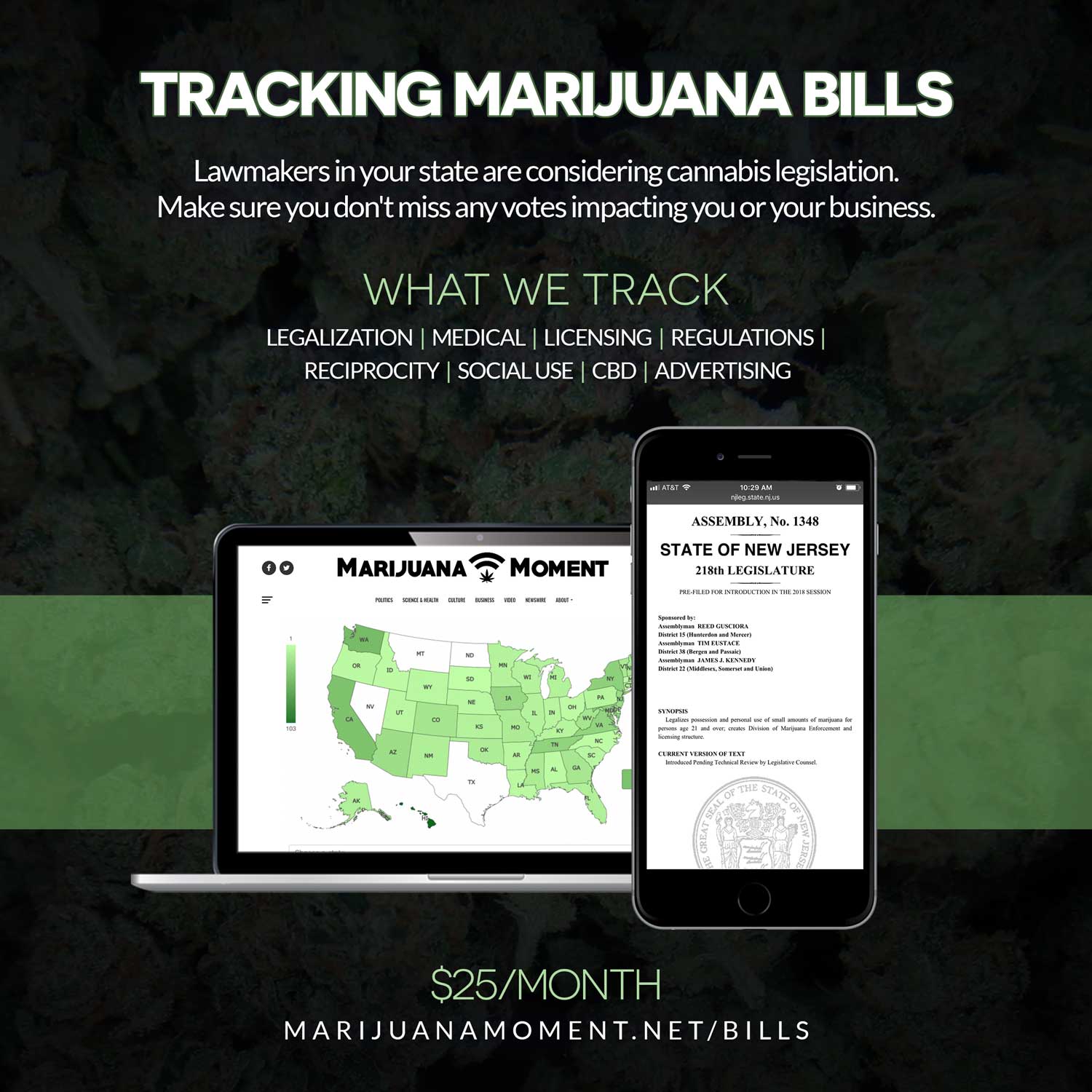

Learn more about our marijuana bill tracker and become a supporter on Patreon to get access.

Meanwhile in Minnesota, the state’s first government-run marijuana retailer recently opened its doors, marking another milestone in the state’s adult-use cannabis program.

Last September, Minnesota officials granted the state’s first-ever marijuana event organizer license, allowing adults to buy and consume cannabis products on-site at a festival. The first non-tribal marijuana shops opened for sales to adults 21 and older earlier that month.

Also last year, the Minnesota city of Eden Prairie sought suggestions from residents on what to name a new, government-branded cannabis gummy product to be sold at municipal liquor stores.

Minnesota’s House of Representatives circulated a poll at last year’s State Fair that asked attendees about the idea of allowing localities to enact bans on marijuana businesses within their borders. Most respondents who have an opinion on the issue agree with the policy, despite it not currently being a part of the state’s cannabis laws.

Ahead of the enactment of legalization in Minnesota, lawmakers’ separate State Fair polls found majority support for the reform.

The governor has also selected a top cannabis regulator for the state who will oversee the adult-use market rollout. Last June, OCM issued the state’s first recreational marijuana license for a cultivation microbusiness.

OCM said at the time that it’s taking further steps to build up in the industry and create opportunities to entrepreneurs, including opening a new licensing window for cannabis testing facilities, accepting the first applications for marijuana event licenses and verifying more social equity status requests.

Separately, after Minnesota lawmakers passed a bill to end the criminalization of bong water containing trace amount of drugsthe governor signed the measure into law last May.

The change addresses an existing policy that had allowed law enforcement to treat quantities of bong water greater than four ounces as equivalent to the pure, uncut version of whatever drug the device was used to consume.

Meanwhile, Minnesota Gov. Tim Walz (D) said in December that the state is “exploring” how to respond to an impending federal ban on hemp THC products, which would be “very disruptive” to a “thriving industry.”

Read the full psilocybin amendment adopted by the Minnesota House below:

Photo courtesy of Wikimedia/Workman.

The post Minnesota Lawmakers Pass Bill To Legalize Psilocybin Therapy appeared first on Marijuana Moment.

Idaho Medical Marijuana Campaign Turns In 150,000 Signatures For Legalization Ballot Measure

An Idaho medical marijuana campaign has announced that it turned in more than 150,000 signatures for a proposed legalization initiative it wants to qualify for the state’s November ballot.

The Natural Medicine Alliance of Idaho (NMAI) announced on Wednesday that it submitted the petitions ahead of last week’s deadline. County clerks across the state now have until June 30 to verify the signatures and report to the secretary of state’s office.

Amanda Watson, a spokesperson for the group, said that the petitions come from all 44 of the state’s counties and are the result of a “rigorous signature gathering effort that stretched to every corner of Idaho.”

“During the work our teams did on the ground to reach Idahoans and obtain the necessary signatures (and well beyond), we were moved and inspired by the many individuals who expressed support, shared their stories and reiterated their appreciation for the democratic process that allows for their voice to be heard through a citizen-led effort,” she said.

“This milestone belongs to the tens of thousands of Idahoans who signed,” Watson said. “Together, we have moved the Idaho Medical Cannabis Act one step closer to the ballot and one step closer to a decision made by the people of Idaho themselves. Now we await the count, and the chance to bring this issue before voters in November.”

At this stage, it’s unclear how many signatures the campaign has collected to far are valid and whether activists have met a separate requirement for regional distribution of petitions.

To be certified for the ballot, the team needs to submit signatures from at least 6 percent of registered voters as of the state’s last general election, which currently amounts to 70,725. They also need to meet that 6 percent threshold in at least 18 of the state’s 35 legislative districts.

While NMAI has pursued ballot access, Idaho lawmakers have pushed back. Both the Senate and House of Representatives passed a resolution this session urging voters to “reject” the medical marijuana petition.

The measure, sponsored by the Senate State Affairs Committee, claims that cannabis legalization in other states has led to a host of harms, including “increased cartel activity, development of black market marijuana production, human trafficking, and increased crime rates” as well as “increased rates of serious health issues,” environmental harms and “safety concerns on job sites.”

It argues that the marijuana initiative would not only increase costs to the state but that its list of approved medical conditions is “so broad that almost anyone could qualify.”

“The Idaho Medical Cannabis Act lacks safeguards to such an extent that it would effectively legalize widespread recreational use of marijuana,” the resolution claims. “The legalization of marijuana would have devastating impacts on Idaho children and their families… The Legislature urges the citizens of Idaho to reject any effort to bring the Idaho Medical Cannabis Act to the ballot.”

A statement of purpose filed with the legislation says it “addresses the devastating impact that legalizing marijuana has had on other states” and “identifies the significant problems” with the ballot initiative.

Contrary to the claims made about marijuana reform in the legislative resolution, advocates often point to data showing that legalizing and regulating cannabis diminishes the size of the illegal market and has not led to increases in youth use.

Meanwhile, NMAI recently released an analysis showing that Idaho could see more than $100 million worth of medical marijuana sold on an annual basis and up to $28 million in new yearly revenue for state coffers if voters  approve the legalization initiative.

The Idaho Medical Cannabis Act, which NMAI unveiled last October, would provide patients with qualifying conditions access to marijuana from a limited number of dispensaries and provide a regulatory framework for the market.

Here are the main provisions of the Idaho Medical Cannabis Act:

  • Health practitioners would be able to recommend medical cannabis to patients with conditions that include, but are not limited to, cancer, anxiety and acute pain.
  • Medical marijuana patients or their designated caregiver could purchase up to 113 grams of smokeable cannabis, or 20 grams of THC extract for vaping, per month.
  • The state would be start by issuing three vertically integrated cannabis business licenses, after which point it could license up to six total.
  • Marijuana would be reclassified under state law as a Schedule II, rather than Schedule I, controlled substance.
  • State and local law enforcement would be barred from assisting in federal drug enforcement activities related to the state-legal cannabis program.
  • There would be anti-discrimination protections for those who use or sell marijuana in compliance from state law, preventing adverse actions by employers, landlords and educational institutions.
  • It does not appear that there would be any equity-centered reforms, nor would the initiative provide for a home grow option.

“We believe Idahoans deserve access to legal, compassionate, natural care right here at home,” NMAI’s website says. “Our mission is to give patients a legal pathway to natural medicine that can ease suffering and restore dignity without the fear of addiction.”

“The Idaho Medical Cannabis Act is our first step forward. It creates a safe, tightly regulated medical program that allows qualified Idahoans to seek medical cannabis treatment with a valid diagnosis from a healthcare provider,” it says. “It supports Idaho agriculture, generates tax revenue to reinvest locally, and ensures that patients can find natural relief.”

The campaign in February also released the results of a statewide poll showing that 83 percent of likely voters back medical cannabis legalization, including 74 percent of Republicans, 95 percent of Democrats and 92 percent of independents.

Asked how they would vote if the current medical cannabis legalization does appear on the November ballot, 76 percent of respondents said “yes.” Of that cohort, 50 percent said they would “definitively” vote yes, and just 21 percent said they’d vote “no.”

After the medical cannabis initiative was unveiled last year, a separate campaign that launched in 2024, Kind Idaho, told supporters that it would be suspending its own signature gathering for a ballot initiative to legalize the personal possession and cultivation of marijuana by adults.

Kind Idaho previously introduced medical marijuana ballot measures intended to go before voters in both the 2022 and 2024 elections, but the efforts proved unsuccessful.

Meanwhile, voters this year will see a different kind of proposal on the ballot: A constitutional amendment that the legislature approved to make it so only lawmakers could legalize marijuana or other controlled substances.


Marijuana Moment is tracking hundreds of cannabis, psychedelics and drug policy bills in state legislatures and Congress this year. Patreon supporters pledging at least $25/month get access to our interactive maps, charts and hearing calendar so they don’t miss any developments.


Learn more about our marijuana bill tracker and become a supporter on Patreon to get access.

Legislators separately held a hearing last year to discuss a bill to enact medical cannabis legalization legislatively, but there hasn’t been meaningful action on the issue in the months since.

Separately, a bill from Rep. Bruce Skaug (R) last year would have set a $420 mandatory minimum fine for cannabis possession, removing judges’ discretion to apply lower penalties. Skaug said the bill, which ultimately stalled in committee, would send the message that Idaho is tough on marijuana.

House lawmakers also passed a bill to ban marijuana advertisements, though the Senate later defeated the measure.

The post Idaho Medical Marijuana Campaign Turns In 150,000 Signatures For Legalization Ballot Measure appeared first on Marijuana Moment.

Florida Republican Governor Candidates Are United In Opposing Marijuana Legalization

“I do not support recreational marijuana. I think the current regulatory system around medicinal use is fine.”

By Mitch Perry, Florida Phoenix

The issue of whether Florida should legalize recreational cannabis went away as a significant campaign issue earlier this year after Smart & Safe Florida, the organization behind an initiative to put it back before voters this November, fell short of the nearly 880,000 verified petition signatures required to qualify for the statewide ballot.

That failure came a year-and-a-half after nearly 56 percent of Floridians voted to legalize adult use of recreational marijuana on the November 2024 ballot, a clear majority but short of the 60 percent required for passage.

While it’s not something voters will  decide this year, Floridians might want to know where their candidates for statewide office stand.

Speaking during a “Business Women for Byron” campaign event Tuesday at the Getaway, a waterfront restaurant and Tiki bar in St. Petersburg, the first question asked by an audience member to GOP gubernatorial candidate Byron Donalds was his position on the topic.

“I do not support recreational marijuana,” Donalds replied. “I think the current regulatory system around medicinal use is fine.”

Donalds has previously acknowledged that he was arrested for possessing “a dime bag of marijuana” as a teenager, and admitted to CBS Miami recently that he actually had sold small amounts of cannabis as a youth.

He now says that he doesn’t support expanding the legal use of weed beyond the 924,820 Floridians listed as qualified medical marijuana patients, according to the state Office of Medical Marijuana Use.

Acceptance On Medical, But Never For Recreational

The other Republicans running for governor share Donalds’s sentiments.

“I oppose recreational marijuana in Florida,” investment firm CEO James Fishback told the Phoenix in a text message. “I have seen what it has done to cities that have already tried it, from New York to Chicago to Washington D.C. The foul stench of pot in public parks and outside our schools can never come to Florida.”

However, Fishback says he will always protect the right of those “with a legitimate medical purpose, including our U.S. military veterans.”

“No one should be denied herbal medicine and pushed toward addictive big pharma prescriptions for pain,” he said. “As Governor, I will protect medical marijuana. But I won’t tolerate hoodlums smoking pot in a public park, just as we already don’t tolerate them drinking in one.”

“I’ve been clear from day one. I am completely against legalizing marijuana,” Lt. Gov Jay Collins said in a video posted on social media on April 26. “We’ve seen the impact in other states, and that’s not where Florida is headed.  I stand with Governor DeSantis on this. No compromises, and no money from the marijuana industry. That can’t be said for all of my opponents.”

“I’m against full blown recreational marijuana,” former House Speaker Paul Renner said Wednesday during a roundtable discussion of high energy prices in Hillsborough County.

“We have medical. It was put in the Constitution [in 2016]. If people want to get it, they can get it. And we opened that up to the extent where it needs to be, but I’m opposed to recreational. Period. If it came back on the ballot, I would campaign against it like Gov. DeSantis did.”

DeSantis announced in June 2024 that he would use a political action committee to fight the constitutional amendment on recreational marijuana, saying he could not believe that the Florida Supreme Court allowed the language of the measure to qualify for that November’s ballot.

He later used tens of millions of taxpayer dollars to campaign against both that proposal and another measure that would have enshrined abortion rights in Florida, according to a report by the Tampa Bay Times.

Where Are The Democrats?

The Phoenix reached out to the two major Democrats running for governor this year: former GOP U.S. Rep. David Jolly and Orange County Mayor Jerry Demings.

“I think the governor’s role is to represent the majority of the state, and the majority of the state asked for it, and I think that we should do it,” Jolly told the Phoenix in a phone call Tuesday.

The Pinellas County Democrat says he actually voted against Amendment 3 in 2024, the one calling for legalizing adult use of recreational marijuana.

But since he announced his candidacy last year, Jolly has emphasized that he would work to implement all recent constitutional amendments that have been passed by a majority of Floridians but failed to get the high 60 percent margin required for passage.

Recreational marijuana got more than 50 percent of the vote in the constitutional amendment process and I pledged to support the enactment and introduce legislatively any amendment that got more than 50 percent of the vote. That includes open primaries, recreational marijuana, and Amendment 4 on reproductive freedom,” he said.

The only major gubernatorial candidate whose stance the Phoenix was unable to clarify was Demings. While serving as the police chief for the city of Orlando in the 2010s, Demings opposed the constitutional amendments that would have legalized medical marijuana in both 2014 and 2016.

The Phoenix reached out by phone and by email to the Demings campaign for two days this week but did not receive a response. Calls to the phone number listed on the most recent press release from the Demings campaign were answered by a recording saying that the person with the number had not set up a voice mail system.

President Trump Endorsed Amendment 3

One prominent Florida Republican who supported Amendment 3 in 2024 was President Donald Trump.

“As I have previously stated, I believe it is time to end needless arrests and incarcerations of adults for small amounts of marijuana for personal use. We must also implement smart regulations, while providing access for adults, to safe, tested product,” Trump posted on Truth Social in September 2024. “As a Floridian, I will be voting YES on Amendment 3 this November.”

In that post, the president promised that if elected back to the White House he would work towards changing marijuana from a Schedule I drug under the Controlled Substances Act to a Schedule III drug—which he did in December in an executive order.

The U.S. Department of Justice announced last month that it would immediately move FDA-approved marijuana products, along with items regulated by a state medical marijuana license, to Schedule III. That puts medical cannabis into the group of regulated drugs with recognized medical uses, such as Tylenol, rather than Schedule I drugs, like heroin and LSD, which are considered to have no medical use and have a high potential for abuse.

This story was first published by Florida Phoenix.

Photo courtesy of Philip Steffan.

The post Florida Republican Governor Candidates Are United In Opposing Marijuana Legalization appeared first on Marijuana Moment.

Missouri Governor Says Restricting Hemp THC Products Is ‘Something We Need To Get Done’ As Ban Bill Heads To His Desk

Missouri’s governor says the state needs to take steps to restrict the availability of intoxicating hemp-derived THC products in line with legislation that lawmakers recently sent to his desk.

“At a high level, I’m very much in favor of taking these illegal drugs in the form of the candies and stuff off of the shelves for kids to be able to buy,” Gov. Mike Kehoe (R) said in an episode of  This Week in Missouri Politics that aired on Sunday.

While the governor said his office will “do bill review” on the specific provisions of the legislation that lawmakers passed last week, he generally agrees with its aim.

“The way the legislation is drawn up is it helps us match the federal standard that’s coming down on these issues,” Kehoe said, referring to national restrictions that President Donald Trump signed into law late last year and that are set to take effect this November.

“So it gives everybody, retailers, I think, until November, to get their shelves corrected and get in the right spot,” he said. “But, definitely something we need to get done.”

The legislation that Kehoe is set to decide on, HB 2641 from Rep. Dave Hinman (R), would largely align the state with the forthcoming new federal rules removing products containing more than 0.4 milligrams of total THC per container from the definition of legal hemp.

Under the Missouri bill, “hemp-derived cannabinoid products shall be considered marijuana and shall be subject to the legal framework” of the state’s marijuana law “under which the purchase, possession, consumption, use, delivery, manufacturing, and sale of marijuana is regulated” by the Department of Health and Senior Services.

The restriction would take effect on November 12, the same date the federal policy is set to go into force.

The legislation also contains provisions to protect marijuana consumers’ privacy and recognize cannabis industry workers’ right to unionize under amendments added in the Senate.

The post Missouri Governor Says Restricting Hemp THC Products Is ‘Something We Need To Get Done’ As Ban Bill Heads To His Desk appeared first on Marijuana Moment.

Louisiana Senators Approve Bill To Allow Medical Marijuana Use In Hospitals For Terminally Ill Patients

A Louisiana Senate panel has advanced a bill to allow patients with terminal and irreversible conditions to use medical marijuana in hospitals.

The Senate Health and Welfare Committee approved the legislation, SB 270 from Sen. Katrina Jackson-Andrews (D), with amendments, in a voice vote on Wednesday.

“This bill was brought at the request of constituents who believe that therapeutic medical marijuana, which is already legal in this state, should be offered in hospitals when patients are terminally ill or otherwise in need the comfort of this medicine,” Jackson-Andrews said ahead of the vote.

Under the proposal, hospitals would have to create written guidelines allowing covered patients to consume medical cannabis on-site in forms other than smoking or vaping.

Under an amendment adopted by the panel, emergency or outpatient departments would be exempted from the policy. The revised legislation also clarifies that patients and primary caregivers are responsible for acquiring and administering medical marijuana, which must be “stored securely at all times in a locked container provided by the patient.”

Health care professionals and staff would be prohibited from “administering, storing, retrieving, or assisting the patient with the medical marijuana,” the text says.

The amendment, which the sponsor worked on with help from the Louisiana Hospital Association, also allows hospitals to opt out of the policy if federal officials take action against any healthcare facility in the state over medical cannabis use, rather than only allowing those that were specifically targeted to stop complying.


Marijuana Moment is tracking hundreds of cannabis, psychedelics and drug policy bills in state legislatures and Congress this year. Patreon supporters pledging at least $25/month get access to our interactive maps, charts and hearing calendar so they don’t miss any developments.


Learn more about our marijuana bill tracker and become a supporter on Patreon to get access.

Meanwhile in Louisiana, the Senate Health and Welfare Committee last week approved a bill to create a psychedelic-assisted therapy pilot program, using opioid settlement dollars to fund clinical trials aimed at developing alternative treatments such as psilocybin and ibogaine.

Lawmakers are also considering a bill to create an adult-use marijuana legalization pilot program in the state to determine whether the reform should eventually be expanded and permanently codified.

The post Louisiana Senators Approve Bill To Allow Medical Marijuana Use In Hospitals For Terminally Ill Patients appeared first on Marijuana Moment.

NRA Joins Marijuana Groups Urging Supreme Court To Overturn Ban On Gun Ownership By Cannabis Consumers As Unconstitutional

The National Rifle Association (NRA)–arguably the most influential gun rights lobbying group in the U.S.—has joined top drug policy reform organizations and other interests in urging the U.S. Supreme Court to declare the federal ban on gun ownership by marijuana consumers unconstitutional.

In one of the latest amici briefs to be filed ahead of oral arguments in a case before the court, U.S. vs. Hemani, NRA called on justices to uphold a lower court ruling that found the federal statute known as 18 U.S.C. § 922(g)(3) violates the Second Amendment.

The filing came amid other new filings from leading reform groups NORML and the Drug Policy Alliance (DPA).

Central to the arguments from NRA and the drug policy organizations is that, based on separate Supreme Court precedent on gun restrictions, barring marijuana users from buying or possessing firearms lacks historical analogues consistent with the nation’s founding and is inconsistent with the increasing social acceptance of marijuana as states continue to legalize if for medical or recreational purposes.

“To justify firearms prohibition for marijuana users when they are not intoxicated, the government must prove that the ban is consistent with our nation’s historical tradition of firearm regulation,” NRA said. “That tradition supports restrictions on the use of firearms while intoxicated, but it does not support disarming individuals when they are sober merely because they sometimes use intoxicants.”

“Throughout American history, legislatures recognized that intoxication could temporarily increase the danger of firearms misuse. But they did not respond by entirely disarming people based on their status as users,” the brief filed alongside other Second Amendment groups said. “Instead, historical intoxication laws regulated conduct: restricting the carrying, discharge, or purchase of firearms only while a person was intoxicated and only for as long as that condition lasted. The historical record thus reflects a consistent tradition of narrow, situational restrictions rather than categorical disarmament.”

“Bereft of relevant support, the government elides the historical tradition of ‘firearm regulation,’ and instead offers strained analogies to civil-commitment laws for alcoholics who could not manage their affairs and to vagrancy laws that detained people in forced labor for loafing, juggling, or wearing the clothes of the opposite sex,” the brief states. “The government also cites surety laws, but those laws undermine its case because they required an individualized judicial finding of dangerousness.”

“Besides contradicting the specific American historical tradition about regulating firearms and intoxicants, the prosecution of Hemani for marijuana use violates a broader rule: individual disarmament must be based on dangerousness. Yet the government has made no serious effort to establish a connection between marijuana use and dangerousness. Rather than focusing on marijuana, it discusses drugs in the abstract and relies primarily on violent incidents involving methamphetamine, heroin, tranquilizers, quaaludes, and PCP.”

“This Court should hold 18 U.S.C. § 922(g)(3) unconstitutional as applied to Hemani because the government failed to demonstrate that disarming him based on marijuana use is consistent with the nation’s historical tradition of firearm regulation,” NRA concluded. “The judgment below should be affirmed.”

Relatedly, last year NRA’s lobbying arm said that court decisions calling into question the constitutionality of the federal government’s ban on gun ownership by marijuana consumers had “led to a confusing regulatory landscape” that’s impacted Americans’ Second Amendment rights.

NORML, for its part, said in its brief on the current case that the Second Amendment “protects ‘the right of the people to keep and bear Arms,’” and cannabis consumers “are plainly among ‘the people’ to be afforded its protection.”

“They are not aliens, enemy combatants, or some constitutionally excluded caste,” it says. “They are ordinary citizens and residents, many of them veterans, workers, parents, and medical patients, who happen also to consume a plant that Congress still places in Schedule I, but partially protects and promotes in interstate commerce by means of spending appropriations measures.”

Justice determined in an earlier ruling that gun laws must be rooted in historical precedent going back to the founding principles enshrined in the U.S. Constitution. And both NORML and DPA seized on that point in their respective briefs.

“The closest historical analogues concern temporary restrictions on carrying or firing a weapon while actually intoxicated,” NORML said. “Those laws did not impose a continuing disability on persons who drank alcohol or used other intoxicants, and they certainly did not strip those persons of their right to possess arms in their homes.”

The organization went further, noting that cannabis itself “underscores the historical mismatch at the heart of this case.”

“Hemp was a familiar and ubiquitous commodity from the colonial period through Reconstruction: colonial governments affirmatively promoted—and in Virginia required—its cultivation; members of the Founding generation grew it; and by the nineteenth century cannabis preparations were widely used medicinally and recognized in standard pharmaceutical compendia,” it said. “Yet neither the Founding era nor Reconstruction produced any tradition of disarming cannabis users as a class, or treating mere cannabis use as a proxy for dangerousness sufficient to justify categorical deprivation of the right to keep and bear arms.”

Additionally, NORML said modern policy “underscores the irrationality of applying § 922(g)(3) categorically to cannabis users, as a “substantial majority of States now authorize the medical use of cannabis, and many also permit adult-use possession under comprehensive regulatory regimes.”

“These widespread legislative judgments reflect the reality that cannabis use is both common and socially normalized, rather than a marker of dangerousness sufficient to justify the permanent deprivation of a fundamental constitutional right,” it said. “Congress itself has repeatedly reinforced that accommodation by prohibiting the Department of Justice from using appropriated funds to interfere with States’ implementation of medical-cannabis laws.”

“Historically, going back 400 years, cannabis in and of itself has not been viewed a harmful plant or a threat,” it continued. “Only since the 1930s and beyond with its Schedule I designation under the Controlled Substances Act of 1970 has it been so relegated–which has been acknowledged as being for political reasons.”

“Cannabis users are among ‘the people’ whose right to keep and bear arms the Second Amendment protects. For centuries, Americans cultivated, consumed, and prescribed cannabis without any suggestion that doing so warranted the loss of firearms rights. State-authorized medical cannabis patients continue to do so today, under regimes Congress has repeatedly chosen to protect. The historical analogues the government identifies concern temporary restrictions on carrying or discharging weapons while actively intoxicated, or disarmament of persons adjudged dangerous—not blanket bans on all users of a disfavored substance. Section 922(g)(3), as applied here, is a modern, statusbased firearm prohibition of unprecedented breadth. It is not consistent with this Nation’s historical tradition of firearm regulation.”

DPA, for its part, said in a brief that the Constitution’s “prohibition on vague laws protects the separation of powers by ensuring that Congress, rather than police, prosecutors, or judges, defines what conduct is criminal.”

“It also protects ordinary people by requiring a criminal law to be sufficiently definite to provide notice of what the law prohibits,” it said. “The statute at issue here, 18 U.S.C. § 922(g)(3) (the Statute), violates this precept because it prohibits an ‘unlawful user’ of ‘any controlled substance’ from possessing a firearm, without defining the quantity, frequency, or timing of the use that triggers its application.”

“The Government disagrees. It reasons that, if this Court reads certain terms into the Statute, then that modified version of § 922(g)(3) is not unconstitutionally vague, as applied to Mr. Hemani,” it said. “It argues, without relevant authority, that the Statute operates as a “temporary” disarmament that reaches only ‘habitual’ drug users. The Government’s interpretation does not remotely reflect the Statute’s capacious reach.”

“In our constitutional order, a vague law is no law at all. Congress is the only branch that has the power to enact federal criminal laws. Allowing this prosecution to proceed under § 922(g)(3) as applied here would require this Court to supply the limiting principle Congress omitted and to decide when the Statute applies and to whom. That approach only furthers the inequitable, selective criminalization of drug use. It has little, if anything, to do with regulating firearms. This Court should affirm.”

Further, the statute that’s being contested holds “the potential to ensnare tens of millions of Americans. The potential consequences are dire: A gun owner with no prior criminal history who experiments with marijuana can suddenly—without any individualized determination of dangerousness—be stripped of their constitutional right to possess a firearm, be subject to felony penalties and, depending on their domicile, be prohibited from voting in elections due to the collateral consequences of a felony conviction.”

“In a nation where marijuana consumption is as common as alcohol use, it cannot be the law that any American who uses marijuana forfeits their constitutional right to firearm possession,” the brief states, adding that the “Government attempts to defend § 922(g)(3) by implicitly relying on the assumption that drug use meaningfully correlates with dangerousness. Those claims are not supported by sound data.”

“Whatever its policy aims, § 922(g)(3) does not condition criminal liability on any finding of dangerousness, impairment, or misuse of a firearm,” it said. “The Government’s attempt to justify the Statute by reference to generalized correlations asks this Court to supply limiting principles that Congress did not enact. This Court’s vagueness doctrine forbids that exercise.”

“The notion that a person may be vaguely labeled as an ‘unlawful user’ and subsequently deprived of a fundamental liberty is irrational. Nor is it rooted in any equitable historical tradition of the United States,” the brief concludes. “The Statute operates as an unbounded, indiscriminate deprivation of fundamental liberties and should not be tolerated.”

In addition to NORML and DPA, several gun rights groups joined the chorus with their own amici briefs opposing the firearm ban for cannabis consumers this week.

In an amicus brief filed with the Supreme Court on Thursday, the Second Amendment Foundation (SAF), California Rifle and Pistol Association (CRPA), Second Amendment Law Center (2ALC), Citizens Committee for the Right to Keep and Bear Arms and Minnesota Gun Owners Caucus (MGOC) identified a number of legal issues with the underlying federal statute, 18 U.S.C. § 922(g)(3).

Because the court selected U.S. vs. Hemani instead of other more marijuana-specific cases challenging the constitutionality of the federal ban, the amici called it an “exceptionally poor vehicle to decide such an important question.”

More recently, the Firearms Policy Coalition, National Association for Gun Rights and New York State Rifle & Pistol Association submitted briefs in the case. Also, the National Association of Criminal Defense Lawyer (NACDL) and Center for Human Liberty filed briefs urging the court to find the current ban unconstitutional.

All of these amici briefs were filed days after ACLU attorneys representing Hemani made the case that the federal ban on gun ownership by marijuana consumers is nonsensical and unconstitutional—and that it’s made all the more confounding by the fact that Trump directed the expeditious finalization of a rule to move cannabis from Schedule I to Schedule III of the Controlled Substances Act (CSA).

The Supreme Court is scheduled to hear oral arguments in the Hermani proceedings on March 2.

In the background, the Bureau of Alcohol, Tobacco, Firearms, and Explosives (ATF) recently moved to loosen rules that bar people who consume marijuana and other illegal drugs from being able to lawfully purchase and possess guns by making it so fewer people would be affected.

The interim final rule from ATF seeks to update the definition of “unlawful user of or addicted to any controlled substance” under an existing policy that has been interpreted to deny Second Amendment rights to people who have used illegal substances a single time within the past year.

Last month, meanwhile, attorneys general for 19 states and Washington, D.C. filed their own brief siding with the federal government in the Hemani case, insisting that justices should maintain the current § 922(g)(3) statute.

Several other briefs were also submitted last month for the case, which was granted cert in October. Firearm control groups including Everytown for Gun Safety, Second Amendment Law Scholars, Brady Center to Prevent Gun Violence, Giffords Law Center to Prevent Gun Violence and Global Action on Gun Violence have told the Supreme Court to overturn the lower court’s ruling in the matter, for example. A coalition of history and law professors also submitted a brief.

Also last month, Smart Approaches to Marijuana (SAM) and 21 other prohibitionist groups filed a brief, urging justices to uphold the constitutionality of the federal gun ban for people who use cannabis—which they claim is associated with violence and psychosis.

U.S. Solicitor General D. John Sauer, for his part, told the Supreme Court that people who use illegal drugs “pose a greater danger” than those who drink alcohol.

Meanwhile, the Biden administration was evidently concerned about potential legal liability in federal cases for people convicted of violating gun laws simply by being a cannabis consumer who possessed a firearm, documents recently obtained by Marijuana Moment show.

The previously unpublished 2024 guidance from former President Joe Biden’s Justice Department generally cautioned U.S. attorneys to use discretion in prosecuting federal cannabis cases, particularly for offenses that qualified people for pardons during his term. But one section seems especially relevant as the Supreme Court takes on a case challenging the constitutionality of the current federal gun statute.

With respect to Hemani, in a separate August filing for the case, the Justice Department also emphasized that “the question presented is the subject of a multi-sided and growing circuit conflict.” In seeking the court’s grant of cert, the solicitor general also noted that the defendant is a joint American and Pakistani citizen with alleged ties to Iranian entities hostile to the U.S., putting him the FBI’s radar.

If justices declare 922(g)(3) constitutional, such a ruling could could mean government wins in the remaining cases. The high court recently denied a petition for cert in U.S. v. Cooper, while leaving pending decisions on U.S. v. Daniels and U.S. v. Sam.

The court also recently denied a petition for cert in another gun and marijuana caseU.S. v. Baxter, but that wasn’t especially surprising as both DOJ and the defendants advised against further pursing the matter after a lower court reinstated his conviction for being an unlawful user of a controlled substance in possession of a firearm.

Meanwhile, in recent interviews with Marijuana Moment, several Republican senators shared their views on the federal ban on gun possession by people who use marijuana—with one saying that if alcohol drinkers can lawfully buy and use firearms, the same standard should apply to cannabis consumers.

Separately, the U.S. Court of Appeals for the Tenth Circuit last year sided with a federal district court that dismissed an indictment against Jared Michael Harrison, who was charged in Oklahoma in 2022 after police discovered cannabis and a handgun in his vehicle during a traffic stop.

The case has now been remanded to that lower court, which determined that the current statute banning “unlawful” users of marijuana from possessing firearms violates the Second Amendment of the Constitution.

The lower court largely based his initial decision on an interpretation of a Supreme Court ruling in which the justices generally created a higher standard for policies that seek to impose restrictions on gun rights.

In the U.S. Court of Appeals for the Eleventh District, judges recently ruled in favor of medical cannabis patients who want to exercise their Second Amendment rights to possess firearms.

As a recent report from the Congressional Research Service (CRS) explained the current legal landscape, a growing number of federal courts are now “finding constitutional problems in the application of at least some parts” of the firearms prohibition.

In another ruling, a three-judge panel for the U.S. Court of Appeals for the Eighth Circuit vacated a defendant’s conviction and remanded the case back to a district court, noting that a retrial before a jury may be necessary to determine whether cannabis in fact caused the defendant to be dangerous or pose a credible threat to others.

The Third Circuit separately said in a published opinion that district courts must make “individualized judgments” to determine whether 922(g)(3) is constitutional as applied to particular defendants.

A federal court in October agreed to delay proceedings in a years-long Florida-based case challenging the constitutionality of the ban on gun ownership by people who use medical marijuana, with the Justice Department arguing that the Supreme Court’s recent decision to take up Hemani warrants a stay in the lower court.


Marijuana Moment is tracking hundreds of cannabis, psychedelics and drug policy bills in state legislatures and Congress this year. Patreon supporters pledging at least $25/month get access to our interactive maps, charts and hearing calendar so they don’t miss any developments.


Learn more about our marijuana bill tracker and become a supporter on Patreon to get access.

Last year, a federal judge in Rhode Island ruled that the ban was unconstitutional as applied to two defendants, writing that the government failed to establish that the “sweeping” prohibition against gun ownership by marijuana users was grounded in historical precedent.

A federal judge in El Paso separately ruled in 2024 that the government’s ongoing ban on gun ownership by habitual marijuana users is unconstitutional in the case of a defendant who earlier pleaded guilty to the criminal charge. The court allowed the man to withdraw the plea and ordered that the indictment against him be dismissed.

DOJ has claimed in multiple federal cases over the past several years that the statute banning cannabis consumers from owning or possessing guns is constitutional because it’s consistent with the nation’s history of disarming “dangerous” individuals.

In 2023, for example, the Justice Department told the U.S. Court of Appeals for the Third Circuit that historical precedent “comfortably” supports the restriction. Cannabis consumers with guns pose a unique danger to society, the Biden administration claimed, in part because they’re “unlikely” to store their weapon properly.

Meanwhile, some states have passed their own laws either further restricting or attempting to preserve gun rights as they relate to marijuana.

Recently a Pennsylvania lawmaker introduced a bill meant to remove state barriers to medical marijuana patients carrying firearms.

Colorado activists also attempted to qualify an initiative for November’s ballot that would have protected the Second Amendment rights of marijuana consumers in that state, but the campaign’s signature-gathering drive ultimately fell short.

As 2024 drew to a close, the ATF issued a warning to Kentucky residents that, if they choose to participate in the state’s medical marijuana program that’s set to launch imminently, they will be prohibited from buying or possessing firearms under federal law.

The official said that while people who already own firearms aren’t “expected to” turn them over if they become state-legal cannabis patients, those who “wish to follow federal law and not be in violation of it” must “make the decision to divest themselves of those firearms.”

Since then, bipartisan state lawmakers have introduced legislation that would urge Kentucky’s representatives in Congress to amend federal law to clarify that users of medical marijuana may legally possess firearms, though no action has since been taken on that bill.

Kentucky Gov. Andy Beshear (D) said last year that he supported the legislature’s effort to urge the state’s congressional delegation to call for federal reforms to protect the Second Amendment rights of medical marijuana patients, but the governor added that he’d like to see even more sweeping change on the federal level.

The post NRA Joins Marijuana Groups Urging Supreme Court To Overturn Ban On Gun Ownership By Cannabis Consumers As Unconstitutional appeared first on Marijuana Moment.

Win for self defending Cannabis users!

Big win for freedom lovers and cannabis patients! The Eleventh Circuit just told Uncle Sam to chill out—medical marijuana users *can* own guns, thank you very much. After years of being lumped in with felons and dangerous criminals, law-abiding patients are finally getting the constitutional respect they deserve. The court said loud and clear: using state-legal cannabis doesn’t make you a threat—it makes you a human with rights.

This ruling could shake up federal policy and send shockwaves all the way to the Supreme Court. If you care about liberty, logic, and the end of reefer madness in gun laws, this is one to watch.

💥 Want the full scoop on the case, the plaintiffs, and what’s next? [Read the full article on Marijuana Moment](https://www.marijuanamoment.net/federal-appeals-court-gives-medical-marijuana-patients-who-want-to-own-guns-a-win/?sfnsn=mo&fbclid=IwY2xjawMUsZRleHRuA2FlbQIxMQABHvHWRvlZ5J9Qq395iJ26RGTgOJ_VLsKp4-TOyvNpaZX_bLIco_I4olpU9d5M_aem_dE5PcP1ojBaRl66PSXg5Bw)—and let’s keep pushing for policy that makes sense.