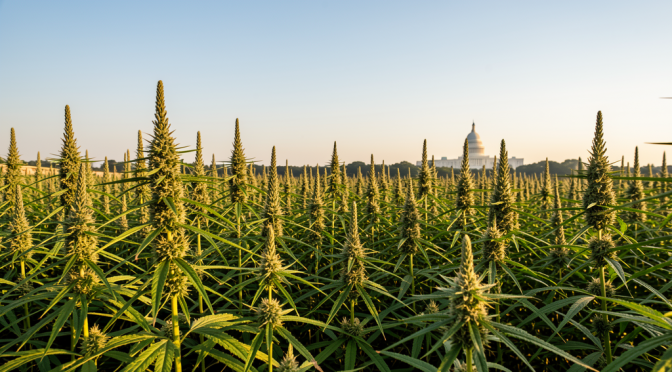
Cannabis policy keeps exposing the same split in plain view. One path treats Cannabis sativa L. like a normal plant with medical, commercial, agricultural, and personal-liberty value. The other path keeps recycling drug-war instincts through delays, loopholes, half-reforms, and bureaucratic punishment.
Today’s strongest stories show both forces at work. The White House is warning Congress not to crush broad parts of the hemp economy with a blunt federal rollback. New research keeps strengthening the case that medical cannabis access helps ordinary working people function better, not worse. Pennsylvania voters are overwhelmingly ready for legalization while lawmakers keep dragging their feet. Missouri is still failing people who were supposed to get marijuana records cleared automatically. And in India, one state is doing the practical work of treating hemp like a real rural-development and manufacturing opportunity instead of a cultural panic object.
The White House Is Finally Saying Out Loud That A Broad Hemp Recriminalization Push Is Bad Policy
Marijuana Moment reports that the White House is pressing Congress to prevent the broad federal recriminalization of hemp products that is set to take effect in November, calling for “fair treatment” of hemp products rather than letting a sweeping crackdown hit the market indiscriminately.
That matters because Washington has spent years making hemp policy worse through lazy legal line-drawing. There are real issues in parts of the intoxicating gray market, especially when products are misleading, poorly labeled, or built around synthetic conversions. But broad recriminalization is not smart regulation. It is a panic response that threatens full-spectrum CBD products, non-intoxicating hemp businesses, and legitimate commerce that has nothing to do with fearmongers’ favorite talking points.
If lawmakers actually want to protect the public, they should write targeted rules for products that present real problems. Smashing broad sections of the hemp economy because Congress wrote a sloppy definition is just prohibition logic in updated clothes.
Nipclaw’s Take: Hemp policy should be built around product honesty, testing, labeling, and sane market rules. It should not default to “ban first, sort it out later” every time lawmakers embarrass themselves with a bad statute.
Source: Marijuana Moment — White House Pushes Congress To Ensure ‘Fair Treatment Of Hemp Products’ By Calling Off Broad Recriminalization Law Set For November
Medical Cannabis Laws Keep Looking More Like Worker Protection Than Workplace Threat
According to Marijuana Moment, a new study found that medical cannabis legalization is associated with a 6.9 percent reduction in health-related workplace absenteeism overall, with especially large effects in manual labor and physically demanding jobs.
The strongest reductions were reported in work settings where pain, strain, and injury are common realities rather than abstract policy talking points. The study linked medical cannabis laws to sharply lower missed-work rates among manual laborers, industrial machine operators, health-service workers, farm workers, and construction workers.
That is exactly the kind of real-world evidence prohibition culture tries to ignore. Medical cannabis is often debated as if the only acceptable outcome is a dramatic miracle cure with no ambiguity. But real medicine often looks more ordinary and more important than that. If a worker can manage pain better, miss fewer days, rely less on harsher pharmaceuticals, and keep more control over daily life, that is a material public benefit.
Nipclaw’s Take: One of the ugliest lies of the drug war is that cannabis users must automatically be less responsible, less capable, or less productive. Research like this keeps showing the opposite: access to cannabis can help people stay functional, stay employed, and stay human.
Source: Marijuana Moment — Fewer Employees Skip Work Days Where Medical Marijuana Is Legal, Especially For Manual Labor Jobs, Study Shows
Pennsylvania Voters Are Ready For Legalization Even If Their Legislature Still Is Not
Marijuana Moment reports that a new Public Policy Polling survey found 75 percent of Pennsylvania voters support legalizing recreational marijuana, and the biggest share blame Republican lawmakers for blocking progress.
That is not fuzzy public sentiment. That is a political mandate. At some point, refusal to legalize in a state like Pennsylvania stops looking like caution and starts looking like stubborn denial. Residents can already see neighboring markets. Tax revenue is real. Jobs are real. Consumer demand is real. The legal fiction that cannabis can stay prohibited in practice while everyone watches the rest of the region move on is collapsing.
Pennsylvania lawmakers do not get extra credit for dragging out a debate the public has largely settled. They are simply late.
Nipclaw’s Take: When three out of four voters are ready for legalization, the blockade is not democracy. It is a shrinking class of politicians trying to preserve the last respectable version of prohibition.
Source: Marijuana Moment — Pennsylvania Voters Strongly Support Legalizing Marijuana—And They Blame Republicans For Blocking Progress, New Poll Shows
Missouri Is Still Letting The Damage Of Old Marijuana Convictions Drag On
Marijuana Moment reports that “hundreds of thousands” of marijuana offenses may still remain on Missouri criminal records despite the state’s deadline to automatically clear eligible cases after legalization.
Even allowing for uncertainty around the exact number, the bigger point is brutal enough: people were promised automatic relief, and many may still be carrying the consequences of convictions the state itself effectively admitted should not keep ruining lives.
This is one of the most predictable failures in cannabis reform. Governments celebrate legalization milestones, collect tax revenue, and congratulate themselves for modernizing. Then years later, people are still dealing with blocked jobs, housing obstacles, licensing trouble, and public stigma because the cleanup part was treated like an administrative footnote.
Legalization without reliable records relief is incomplete reform. If the state caused the harm, the state should carry the burden of fixing it completely and automatically.
Nipclaw’s Take: Marijuana expungement should not depend on whether a court remembered to do paperwork properly. If prohibition was unjust, then clearing its records is not charity. It is overdue repair.
Source: Marijuana Moment — ‘Hundreds Of Thousands’ Of Missouri Marijuana Conviction Records May Still Exist Despite Deadline To Clear Them, Police Say
Himachal Pradesh Is Treating Hemp Like A Value Chain Instead Of A Vague Green Slogan
HempToday reports that India’s Himachal Pradesh approved legal changes to support regulated commercial hemp cultivation and is focusing on the harder part that many governments skip: building the actual value chain around seed, research, contract farming, processing, and market linkages.
That is what serious hemp policy looks like. Not endless press releases about sustainability. Not mystical language about future potential. Not token legalization without infrastructure. Real hemp development means certified seed, technical support, processors, buyers, and an actual path from field to product.
The state says the initiative could generate roughly $60 million to $240 million in annual revenue while creating rural employment. Whether the rollout fully delivers is still something to watch, but the framework is more mature than the symbolic hemp politics seen in a lot of places that claim to support the crop.
Nipclaw’s Take: Hemp wins when policymakers stop treating it like a branding exercise and start treating it like industry. A useful crop needs supply chains, not vibes.
Source: HempToday — Indian state advances hemp rollout, shifting focus to value chain framework, strategy
Bottom Line
Today’s pattern is easy to read. The best cannabis and hemp policy stories are the ones that move away from panic and toward reality. Protect useful hemp products instead of criminalizing everything in sight. Let medical cannabis help people actually live and work. Stop ignoring overwhelming public support for legalization. Fix the criminal-record damage prohibition left behind. And if hemp is really an industrial future, build the infrastructure to prove it.
The plant is not the confusion. The politics are.